Friday, July 21, 2006


I think you have all been forced to endure my tirades about the latter installments of the Wachowski Brothers’ Matrix trilogy. The first film (released in 1998) revolutionized special effects the same way the original Star Wars films did in 1977. Their style and tricks imitated but never duplicated in ingenuity, the Wachowski brothers turned their creative eyes to completing the Matrix legacy; not only the story of Morpheus, Neo and Trinity, but also the mythology surrounding the computer-generated reality in which the film suggests we all live.

By now it is old news that the second two films (Reloaded and Revolutions) failed to impress the way the first did. And how could they? The story element that made the first film irresistible was old news, and it is an unrealistic expectation that two comic book geeks would be able to stun and surprise the world with yet another incredible story that blows our conceptions of reality.

So Reloaded and Revolutions pass into our distant memory, and yet there was one film project that was released during the height of the phenomenon, (namely: during the four-year anticipation between Matrix I and Reloaded) which explored another of the Wachowski Brothers’ loves: anime. This distinct Japanese animation style has developed a tremendous cult following in the United States during the last decade, so it makes perfect sense that a film project featuring some of the world’s most famous animators and directors would come to fruition.

The Animatrix is a full-length feature film made up of nine short films that delve deeper into the fictional world of the Matrix in a surprisingly meaningful and absorbing way.
Whether it be the beautifully conceived Final Flight of the Osiris, (the only non-traditional animation segment of the film) which features state-of-the-art CGI animation to recount the final voyage of the ship Osiris which is mentioned in passing during the Matrix films, or the Second Renaissance Part 1 & II which recount the “history” of the modern world, and fills in the holes for its audience as to how things became the way the are. At times touching, and others purely horrifying, the films have a much more genuine impact on the audience than the later Matrix films had.

Some are meant to be purely informational, providing us with pieces of the history of our civilization, thereby increasing our understanding of the plight of our heroes in Zion, while other segments show “normal” human beings encountering what amounts to programming errors, and our human instinct interpreting these things as “haunted houses” or UFOs…just the sort of thing that we all wonder about during our real lives the Animatrix offers as “proof” of an even greater vast conspiracy to enslave the human mind.

In many ways, the Animatrix takes the next step from the Matrix, giving us a more in-depth view of its universe, but where the later Matrix films trade human emotion for gymnastics, the Animatrix lingers to give us a true human perspective and experience within this computer-generated world, and so for many reasons, could be far more important to the Matrix universe than either Reloaded or Revolutions.
This film is well worth the time it takes

T.

Thursday, July 20, 2006

Some Photos...


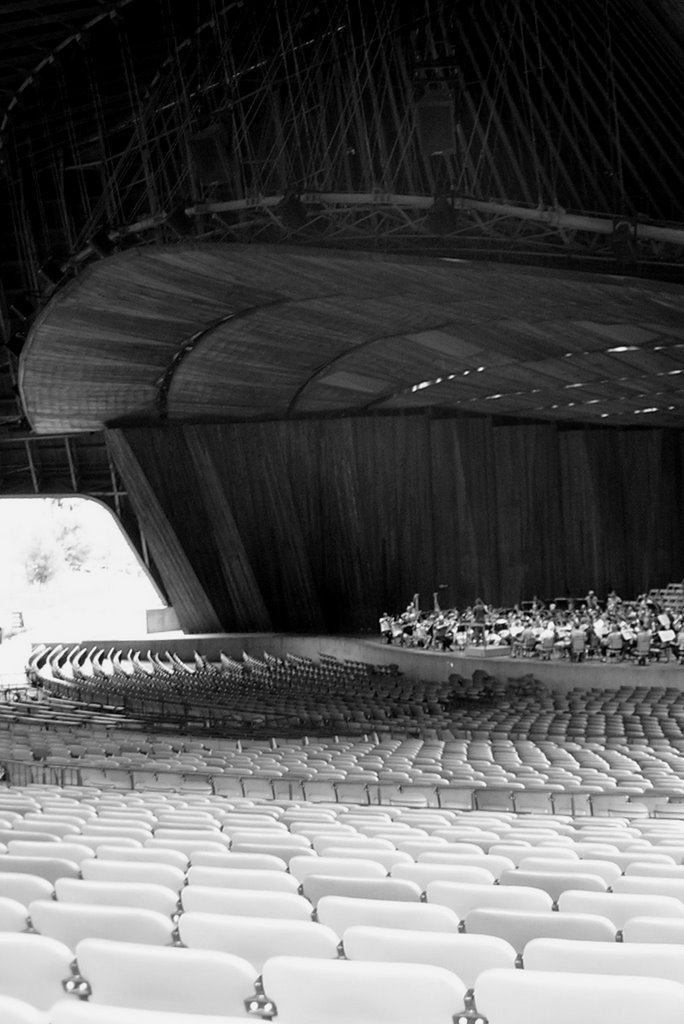
The Cleveland Orchestra on stage at the Blossom Music Center


Yay for figuring out the timer on my digital camera!


Bikes at the University of Wisconsin Madison


Sailing Club, UW Madison


Downtown Chicago from the Sears Tower

T.

I, TMS, do solemly swear (or affirm) that I will support and defend the Constitution of the United States against all enemies, foreign and domestic; that I will bear true faith and allegiance to the same; and that I will obey the orders of the President of the United States and the orders of the officers appointed overme, according to regulations and the Uniform Code of Military Justice. So help me God.

Sunday, July 16, 2006


Music Review: Deadboy & the Elephantmen – We Are Night Sky

Two-piece rock band crafts oddly addictive songs about…nothing.

I heard about this band while wandering through Fat Possum Record’s website. At the time, one of my favorite bands, the Black Keys, were signed to that label. Fat Possum splits its catalog between old-fashioned blues singers like Model-T Ford, and neo-punk rock acts like the Black Keys, the Heartless Bastards, and of course, Deadboy & the Elephantmen.

We Are Night Sky is DB&EM’s latest release. So far, their work is relatively unknown, so you won’t find reviews of their works published in any magazines. I found this CD used, surprisingly, and decided it was worth the time and money to explore a little bit further into Fat Possum’s universe.

I didn’t even know that DB&EM was yet another two-piece band before I bought this CD. It would seem that in the wake of the success of the White Stripes, all two-piece acts are enjoying a little sunlight and record deals. How good their music is, however, is another matter. In the case of DB&EM, Dax and Tessie strke out to truly create a new and unique sonic language for themselves.

All of the songs on this album were written by Dax Riggs and Tessie Brunet, ( vocals & guitars and drums, respectively.) and if listened to enough, they begin to show a certain affinity for certain ideas.
One of which is a bizarre poly-tonal approach to ornamentation. If the chord struck by the guitar is major, Dax has no problem singing a minor third against the major, creating an uncomfortable dissonance that is usually only resolved by yet another clashing use of chords.
Also, the songwriting always enjoys the tonic chord as an anchor. When the song arrives at a downbeat, the chord is clear and uncomplicated, but at any half-cadence, this is where the vocals or solo guitar will sneak in with a grinding dissonance which the ear cannot help but listen to.

The songs on this album are almost equally balanced between a harder-edged fuzzed-out guitar song and melancholic acoustic number, each taking their turn at expressing indecipherable lyrics over churning instrumentals. And yet, I could not bring myself to turn this CD off. I must have listened through this entire album five or six times, and it was easy to really get lost in the tunes.

The Grade: B-

T.

Movie Review: The Devil Wears Prada
Starring: Anne Hathaway, Merryl Streep
Directed by: David Frankel

Based off of the popular novel by Lauren Weisberger, this film had high expectations early in the season, especially since it hinted that the summer of 2006 was moving away from the studio’s usual strategy of blockbuster filmmaking and towards smaller, more independent fare that would hopefully keep the audiences coming in, even if Superman and Pirates of the Caribbean sank at the box office.
Plus, the Streep trophy always guarantees a certain amount of attention. Even if she is cast in a role which invariably ends up in the shadow of Hathaway’s character.

The Premise: Andrea, (Hathaway) has just received her undergraduate degree in journalism and moves to the Big Apple to pursue her dream, and as on-the-way job, lands a position as receptionist for Miranda, (Streep) Editor-in-chief of Runway magazine, one of the world’s preeminent fashion magazines. Andrea has no idea what world she has stepped into, and the movie follows her journey through realization, acceptance, and then eventual self-discovery that leads her down the right path.

The end.

So, having read that, you really don’t need to go see this movie now.

Sadly, this film plays out in such a formulaic, predictable manner, its really saddening. For a film that really did appear to be something deeper, this film ends up having no more breadth than Hathaway’s earlier films such as Ella Enchanted. The movie can only hope that its audience will be captivated enough by watching the dazzling world of haut couture whirl before them that they won’t think about anything else.

Sorry dear, I don’t even know how to spell Yves St. Laurent.

(Oh, I guess I do.)

De La Renta.

Hmmm…never mind.

This story has been told so many times before, I would never have thought that such a rudimentary re-telling of it would be done. The plot devices are predictable and cliché, and sadly the acting does little to deliver us from our misery.

Meryl Streep is, of course, great at what she does, playing the cold, distant and demanding Miranda (the Devil aforementioned.) Her role is minimal, certainly one of the smarter choices she certainly made with this film, making her character more elusive and curious than the others, which is a testament to her skill.

Anne Hathaway took a few years off from filmmaking after her earlier successes with the Disney empire to go to school and “grow up” a bit. A wise decision, but I think Ms. Hathaway still has some growing to do before she should attempt a role next to someone like Meryl Streep. Many of her mannerisms throughout the movie became overused and annoying, as though she was expecting her quirky smile and innocent charm would win us over. She showed no real depth of understanding for her role, which I can only mention because of her vicinity to Streep. Without her there, Hathaway’s performance would have to be evaluated differently, and of course, the entire tone of the movie would change as well.

If high fashion is something you enjoy, pay attention to, etc. then this is a fun film. One of the more fun clichés of the film is when Andrea gets set loose in the closet/warehouse to select a new wardrobe for work. What girl wouldn’t want the opportunity to wear thousands of dollars worth of clothing and accessories every day? I can see the candy-store appeal of that. But from an artistic standpoint, this film is boring and played-out. The only smart thing that director David Frankel does is to not needlessly run long, as so many filmmakers are doing these days. For light, enjoyable fare, let us leave the film while we were still enjoying it.

The Distressed Leather Handbag With Matching Belt and Shoes Grade: C-

T.

Movie Review: Hostel
Starring: Jay Hernandez, Derek Richardson
Directed by: Eli Roth

Quentin Tarantino lent his notoriety to this film project early on, so that, in the end, this film was “presented by” Mr. Tarantino. Needless to say, the director of such modern classics such as Pulp Fiction and Kill Bill vols. 1 & 2 ended up lending huge amounts of credit to this film, which would have otherwise been largely overlooked.
Tarantino regarded this as the scariest movie of the last decade, and considering the volume of work that has been added to the genre of horror in the past few years, you have to at least award high marks for effort.

Eli Roth, director of 2002’s cult classic Cabin Fever, returns to his stomping grounds for another go around of visceral gore.
Reports of this film were as contrasting as possible, with audiences either loving the film, or absolutely hating it. But the one thing everyone agreed on: this film probed such deep depths of depravity previously unthought of by the human mind. Well goodness, that almost sounds good enough to eat, doesn’t it?

I would normally never have seen this movie. I’m just not one much for blood and gore, let alone horror films (although well-handled films can become film classics. Example: Silence of the Lambs; modern day example: Saw,) but my dear friend Lala has a real love for horror films, and her anticipation over seeing this film was high, so I decided to indulge her.

The Premise: Young, loud-mouthed American college students backpack their way across Europe, and head to a tiny Slovakian village in search of untapped female resources, only to find themselves one-by-one being snatched away in the night to face a gruesome death. We all have the pleasure of watching. Or covering your eyes, if you prefer.

This film is so unashamedly pointed towards the very youngest demographic allowed, (the 18-year old high schooler and any 14-year olds who manage to sneak in.) The language is so ridiculously foul, the behavior of the supposed college students is so disgusting that it fulfills every young teenager’s fantasies about what it must be like to be in college. Aside from the ridiculous behavior of our hapless Americans, there is enough gratuitous nudity during the first half of the film whose sole purpose in the film is to draw in the hormone-driven male audience.

The further we get into this film, the more Lala and I realize that this film has less and less appearances of being a horror film, and would seem to qualify more and more for the status of a cult film.

The acting is so poor, the dialogue scenes, (when the film is forced to endure through one) is so canned and predictable that it would seem less likely that the script had been written, but rather borrowed from a second-rate soft-core adult filim.
But we all know that is why we’re watching the movie.

We came for the gore. We came for the guts! The glory?

As it turns out, we get a few moments of truly effective gore, (achilles-slicing, anyone?) but otherwise the film’s scenes of “horror” are full of blood-filled rubber dolls being punctured with any number of pointy objects including (but not limited to) scissors, garden trowel and a power drill. (My personal favorite.)

This film rather quickly becomes so ridiculous that we learn to dismiss the notion of implausibility. The only mental exercise I enjoyed during this film was trying to sort out the one plot element that proved interesting and actually helped boost the quality of the film.

One of the disappointing technical features of this film was the cinematography. In horror/suspense/thriller films over the past ten years, the art of cinematography has been elevated to the level of screenwriting. Combined with good editing, the style in which a film is shot will do a great deal of the filmmakers’ work for them, putting the audience on edge, relaxing us, terrifying us, etc. all with use of color scheme, exposure, camera angles, etc. Hostel disappoints in this department because the entire film is shot in what appears to be basic film stock. Steadicam or dolly cams are used, giving a very stable, steady sense to the camera movement, and colors are very near to true-to-life. In a word: the camera work is boring, and it does nothing to make its audience feel nervous at all about what is happening. Only in the dungeon sequences do we see any sort of interesting lighting effects happening, but by now, the work is merely copying an earlier film.

This film will not go down on any list of great horror films. At least it’d better not.
Expect this to show during Halloween season on AMC’s Creature Feature or some other horror marathon. It will surely develop a cult following, and in that arena, it deserves attention, but the praises lauded to this movie by critics I find completely unwarranted and ridiculous since I laughed more than I screamed during this movie.

The Grade: D (Camp-factor keeps Hostel from falling through the floor.)

Friday, July 14, 2006


Movie Review: Matchstick Men
Starring: Nicholas Cage, Sam Rockwell and Alison Lohman
Directed by: Ridley Scott

This is another film that has already left the “new arrivals” section at Blockbuster. It had its theatrical release way back in 2003, and really only caught my eye because of the director, Ridley Scott.
Scott is far more famous for other additions to American film- Gladiator and Black Hawk Down- which have cemented a sure place for Scott in the annals of cinematic history.

Considering this, Matchstick Men becomes a real departure from Scott’s oeuvre, trading in his action/drama specs for a stab at the sleek sleight-of-hand thriller.
Just like David O. Russel’s I Heart Huckabees, Scott must work from a disadvantage, since this style of film has seen a revival in recent years, and audiences are quick to spot uncomfortable, awkward work.

I am pleased to report, however, that Scott does a great job at adapting his sensitivities to the project at hand, implementing the key ingredient of misdirection masterfully. This film plays the smooth criminal thriller well, except for a few key differences, which serve to push this movie beyond just a good-looking thief film. The end result is a film which almost has a dual identity: a slick robbery flick, and a psychological comedy.

The Premise: Roy (Cage) and Fred (Rockwell) are con artists working in LA, duping innumerable hapless senior citizens out of small-time money, always on the lookout for that bigger score. Roy suffers from any number of neuroses, the most important being his obsessive-compulsive behavior. Self-medicated and lonely, Roy seeks the help of a psychiatrist when his pills run out. Because of these sessions Roy learns that he has a 14-year old daughter, (Lohman) who enters into his life because of a few phone calls. She is accidentally brought in on a con, where Roy discovers her natural affinity for the work. She is brought in on future cons, much to the chagrin of Fred, who is mistrustful, since either he or Roy know literally nothing about her.

The rest of the plot becomes key to a surprise ending that would be shameful to disclose to you who have not seen it. Suffice to say, if you are really alert, you might figure out where you are heading, but for myself, who tends to live a little more “in the moment” when it comes to movies, I was caught off guard, and thus the ruse was a success.

Nicholas Cage’s performance in this film is the first thing I must mention. This may go down as the finest performance I’ve seen Cage give. With the exception perhaps of his dual roles in Adaptation, Matchstick takes Cage further away from the cliché attributes which have plagued him from his earliest days. Audiences either love or hate Cage. It is hard to feel neutral about him because his personality is so unique. In this film, however, I felt Cage explored deeper into a character than I’ve seen from him in a long time.
His portrayal of the obsessive-compulsions that Roy suffers from are not glib or thrown away. In fact, they tread this fine line between humorous and morose, leaving us not quite certain if we should laugh or feel sorry for Roy.
One of Cage’s common detractions is his vocal intonation. He speaks very much in the back of his throat, letting his nose buzz on many words. This is different than any other actor I know of, but it certainly does get old after a while if an actor never moves beyond it. In Adaptation, and now again in Matchstick, Cage adopts a variation of English that takes him away from his common ground.

Ridley Scott’s direction in this film is superb, as I knew it would be. The ability to adapt from one vastly style of film to another is something often times botched by other directors when they move from one genre of film to another. Scott seemed to be well-aware of these challenges, and even managed to stamp his own calling card onto the celluloid.

The one thing that really jumped out at me was the pace of this film. I wasn’t sure what to think at first, because within the first ten minutes we had seen more of Roy’s life than most filmmakers will show in half an hour. Scotts’ cuts are fast and furious, leaving only the most essential of actions left in a shot so that he doesn’t leave us behind. At first I thought this was just the set-up, and the pace would slow once we got to the real part of the story, but the quick camera shots continue at a rapid pace all of the way until the end of the movie. The further we got into the film, however, I realized this was Scott’s way of letting us in on Roy’s world. The sped-up film, over-exposure of certain shots and the quick takes create a surreal sense of events and time, allowing us to see a little bit of the existence that Roy is dealing with. The editing of this work was superb.

Alison Lohman, who plays Angela, Roy’s daughter, is really the weak link in an otherwise exemplary cast. I don’t know if her training or experience, but she really came off to me as practically an amateur, delivering lines the way a first-timer might lean towards a microphone, just to make sure audio picks it all up. I was far less impressed with her performance, but am encouraged that I have not seen her in any other films since 2003.

Over all, I thoroughly enjoyed this movie. I was expecting a tasty con man film, and got much more. The only thing that acts as a detriment to the pace and excitement of this movie is the duality of the film itself. It is both a film about these men’s work, and yet also about Roy’s mind, and all of the turmoil he is put through during this film. Because of this, the pace of the storyline sometimes lagged a little bit too much to keep the audience really into the movie.

The Grade: B+

T.

Wednesday, July 12, 2006


Movie Review: I Heart Huckabees
Starring: Jude Law, Jason Schwartzman, Lily Tomlin, Dustin Hoffman, Mark Wahlberg, Naomi Watts, Isabella Hubbert
Directed by: David O. Russell

Hailed as the “best existential comedy in years,” one quickly realizes that they key qualifier in that sentence might very well mean the “only existential comedy in years.”

If that’s the case, then we really haven’t been missing a whole lot.

David O. Russell, director of one of my favorite movies Three Kings, (which introduced me to the work of actor/director Spike Jonze) takes a real departure from his cinematic vein with this movie. The teasers for this film portray the spirit accurately; i.e., a zany, off-the-wall cerebral comedy that ends up being pretty much about nothing.
This style of comedic film isn’t really anything new, having been pioneered in the last decade by the likes of Spike Jonze (Being John Malkovich, Adaptation) and Wes Anderson (Rushmore, the Royal Tenenbaums, the Life Aquatic.) This being said, this seemed like a movie that would be right up my alley.

The two most important things a film like this requires for success is 1) a director that understands and shares the correct vision for the film, and 2) a script that is solid enough to pull it off. (See Charlie Kaufman’s work as textbook example as a stand-alone mind-screwing.)
This film, sadly, seems to struggle with both.

The Premise: Alfred (Schwartzman) hires two “everything-is-connected” existential detectives (Hoffman and Tomlin) to investigate a series of coincidental run-ins he’s had. Along the way, his nemesis Brad (Law) engages the detectives’ services as well, as well as gains the friendship of a burnt-out fireman (Wahlberg) struggling with the point of the universe.
Just like any business, however, any service is bound to have competitors, and the detectives work to prevent their clients from joining the teachings of rival “the-universe-is-pointless” existentialist Caterine Vauban (Hubbert.) At the end of the day, the fireman finds love again, Alfred sets fire to Brad’s jet skis, and Brad has an emotional breakdown.

Not bad for an hour and forty minutes.

Where the film goes wrong: About ten minutes into it.

On a philosophical and psychological level, this movie is very shallow. I am no scholar on Kafka, Nihilism or even Plato for that matter, but it didn’t take long to realize when this movie stepped out of the stream of intelligent reason and into an oozing puddle of chatter.
Whenever the correct characters were in the same room together and an important plot device was about to be revealed, soon enough the double-talk would make a not-so-surprise visit in a thinly veiled attempt to distract you from the truth that they really had no idea what they were talking about.
Which is fine, by the way! I don’t really care if they made actual sense or not of the plot. It wouldn’t have to be necessary. But the writer chooses to make the existential and transcendental philosophy core to the struggles characters face, thereby dooming the movie to a creamed-corn level of nutritional story-telling.

The great relief and truth that is found during the course of the films’ discourse, however, is that even those who believe in everything (and nothing) must eventually concede that there are ultimately only two truths: truth and deception. And for this movie, that’s quite an admission.
The more soul-searching characters question everything known about human existence from the first minute of film, invariably deciding, (at one point of the film or another) that everyone must be right. (Our favorite topic of conversation: the blurring of right vs. wrong.) However, even this film cannot escape the inevitability of that position. Eventually you will find that one thing that you cannot accept.
In this instance, it occurs in a scene when Alfred is using the meditation technique from one existentialist in the presence of the competing one. She screams at him “those are lies! You are lying to yourself!”
We were way beyond waist-deep in bull by this point, but it was the kernel of truth in the entire movie that essentially destroys their entire philosophy: the admission of truth and deception.

The other great concern with this film was with the director, David O. Russell. As I mentioned earlier, this style of subtle psycho-comic drama isn’t new. Wes Anderson has become a master at coaxing beautiful and tragic performances from his actors (his work with Bill Murray I believe led to Murray’s work on Coppola’s Lost in Translation which garnered Murray an Oscar nomination.) Spike Jonze’s work with Charlie Kaufman’s scripts has been remarkable because of the subtle way he is able to capture the tiniest of details essential to the story without making it obvious. Either of these directors I believe would have had a better feel for the direction this film needed to take. Indeed, in many sequences, it seemed as though Russell was trying to pirate some of their techniques, which only made the film seem even more like a rip-off from a more entertaining, capable moviemaker. (The casting of Schwartzman in the lead role was curious, since he appeared as the lead character in Anderson’s Rushmore.)

I plan on watching I Heart Huckabees again, because there was enough stuff happening in this film that I feel I might have missed a good deal on the first viewing. I don’t believe my opinion of the film will change greatly, so I write this review now, while the film is still fresh in my mind.

The Graaaade: C for less-than-heartwarming tale that ended up confusing the heck out of me.

I know I’ve been handing out a lot of “C’s” recently. Everything’s just been only so-so recently. I hope to encounter warmer waters soon. (Not meant to be a Pirates pun...we'll talk about that in a little while.)

T.

Sunday, July 09, 2006


Movie Review: Con Air
Starring: Nicholas Cage, Steve Buscemi, John Malkovich, Vin Rhames, John Cusack & Dave Chapelle
Directed by: Simon West
Produced by: Jerry Bruckheimer

This film is also not new. Its original theatrical release was nearly ten years ago (1997.) I write this column not as a review of the film but rather as a retrospective of an era of filmmaking that featured such dramatic and elaborate action sequences that it left no room for believable storyline or dialogue. Yet these films will have their own special place in movie history, so devoted they are to the opera of destruction that it is impossible to ignore or forget them.

This whole idea most certainly started with the birth of the 1980’s action film, headlined by such superstars as Arnold Schwarzenegger and Sylvester Stallone. As time progressed, the public appetite for testosterone-drenched cinema showed no sign of ending. The age gives birth to other action heroes such as Jean-Claude van Damme as well as Wesley Snipes and Bruce Willis, each movie studio and production company clambering for their piece of the pie.

The film Con Air represents the peak of excess and glory of this film genre. Soon there after the genre endured life-altering changes from which it never recovered, and action films took on a very different appearance, combining far more realistic circumstances, darker colors, themes and even believable, realistic storylines.

Con Air is a worthy case study for many reasons. Jerry Bruckheimer, more recently responsible for such spectacle-adventure films such as Pirates of the Caribbean, has always had a calling card of destruction and spectacle. With Con Air, the spectacle has never been more visceral, the destruction never more gratuitous, and possibly never more fun.

The Premise: Nicholas Cage plays a convict on the day of his parole, sent home aboard a flight full of hard-core criminals to his family. A mid-air jailbreak ensues, and it is up to our hero to play the devils advocate until the right moment when he can save the day and make it home to his family.

The film begins with such a rapid set-up, that if you aren’t paying attention for the first ten minutes, you’ll be wondering how all of these people got airborne. The whole point of the opening of the film, of course, is to simply get the characters into the midst of the fray so we can watch the insanity begin.

Once airborne, Cage is in his finest mode, spouting deadpan machismo-laden mono-syllabic lines faster than thought humanly possible.

Other characters, such as John Malkovich and Steve Buscemi are allowed to play with their psychotic finest, using all of the disturbing traits of their acting as a springboard to unleash the most frightening assortment of super freaks that moviemakers can imagine. Buscemi plays a Hannibal Lecter-like character who is transported in full protective gear, while Malkovich plays the violent mastermind, who soon is in command of the aircraft.

One fantastic scene to the next follows, pushing us further and further away from the realm of believability, and more and more into the world of explosions, mayhem and expensive pyrotechnics. The bar is pushed so far that the work on this film was even nominated for an Academy Award for sound editing.

This film is fun to watch, but even while its happening I feel guilty, knowing the writing, the acting and the directing is all so blatantly directed at my basest instincts and impulses. It will never be regarded as a great film, but in the world of the super-action film, Con Air must stand next to the best for its sheer ferocity and extravagance, a self-indulgent monument an era of American film that will likely not be repeated any time soon.

The By-The-Way Grade for Con Air: C

T.

Movie Review: The Whole Ten Yards
Starring: Bruce Willis, Matthew Perry, Kevin Pollack, Natasha Henstridge and Amanda Peet
Directed by: Howard Deutch

This is an older movie, but one which I just saw in its entirety. Not only is this movie out on video, but its already seen its network television premiere. I’m behind the pace on this one.

This film is the sequel to 2002’s (more appropriately named) The Whole Nine Yards, where Willis plays mobster hitman Jimmy “the Tulip” Tudeski, who moves to Montreal to start his new life. He moves into a house next to dentist Oz (Perry) and the adventures begin as the Chicago mob learns of Jimmy’s new home, and enlists’ Oz’s help to try and eliminate Jimmy.

In the second film, we pick up right where the first left off. Both of our in-love couples are enjoying a comfortable (if not slightly paranoid) existence, always mindful of being tracked down by the remaining members of the Mob that survived the first film.
Promotions for Ten Yards showed Willis running around in an apron, wearing a housecoat and vacuuming. Its true, he does do this an awful lot during the first part of the film, but we certainly get lots of the cold-hearted killer behavior from the Tulip later on in the film.

Kevin Pollack returns as the father of the character of the film he played in the Whole Nine Yards. Good makeup creates a truly hilarious character, combined with Pollack’s great conception of the Hungarian mobster, complete with a barrage of mis-pronounced vowels.

The great downfall of this film is that the plot is secondary to the jokes which happen between its characters. The fun thing about this is that in this second film, these actors have perfected their relationships with each other (particularly Perry and Willis) and the one-liners are able to fly like crazy.
Being a bit of a fan for the first film, it is fun being able to watch these actors play with each other. You can tell it was a lot of fun for them to work together.
Sadly, they end up sacrificing cohesion and plausibility in the meanwhile.

What we end up with is a playful romp through the comical world of contract killers that is all candy but no meat. I suppose some wouldn’t care if the content of the film ends up being rather fluffy, but my mind is one that always hopes that despite any number of jokes (no matter how funny) that there will be a real story underneath it all.

This movie seems to just enjoy what it is: a dessert-styled film designed to let everyone enjoy the work of these actors without giving us any fussy plot to have to think about.

If I had paid for a ticket in the theater to see this movie, I would have to give it a bad grade, but since I watched this in the comfort of my own home and without cost to myself, the grade jumps up a little bit…

The Kill-Em-Dead-In-Their-Tracks Grade: C+

Friday, July 07, 2006


I had an epiphany…

A certain guilty pleasure I’ve allowed myself to indulge when the opportunity arises is watching reruns of Mtv’s Jack***.

The premise of the show is simple: send a group of 20-something guys out into the unsuspecting world to wreak havoc on all they find, turning even the simplest of pastimes into a potentially deadly extreme sport (i.e. extreme pogo sticking) or simply allowing their friends to shoot them point-blank range in the crotch with a paintball gun.
Sounds painful, no? Yes. And also hilarious.

This show was condemned by parents and all responsible-minded adults for its complete lack of consideration for acceptable social behavior, not to mention the fact that it blatantly promoted any form of self-destructive behavior that the human mind could conjure up. I don’t mean deliberately destructive, but jumping into a shopping cart and then pushing it over an embankment is par for the course.

Mtv gave as stern a warning as they could think of to tell the young stupid children that they shouldn’t try this behavior at home, etc. and the Jack*** crew themselves made it clear they wouldn’t watch or open any home-made submissions of other people trying to imitate them. Despite all of their attempts, the show only survived for a few seasons. Not only did public opinion eventually convince Mtv to pull Jack*** from production, but more interestingly, the boys of Jack*** became some notorious that their pranks seldom worked because unwitting bystanders would recognize them and want them to get in on the action. This drove the crew overseas for the end of the series’ production, where they found anonymity once again.

Juvenile? Yes. Immature? Yes. Childish? Yes. Irresponsible? Yes.

I cannot debate the moral relevance of this television show. The whole idea is reprehensible to have adults behaving in such immature ways, engaging in all of the behavior our mommies always told us not to.

So the popularity of this show is no surprise. Many people just watched it because it was the forbidden fruit. Either their parents forbade them to watch it, or it allowed us to live a tiny part of things we always wished we’d gotten to do.

And yet there’s me. I didn’t discover this show until its tenure on Mtv was nearly over. Certainly not any earlier than my junior year of college did I learn of the antics of Steve-O, Wee Man, Johnny Knoxville and Chris Pontius.
Yes, I laughed at all of the groin shots, the potty humor and wreckless self-destruction, but I now realize that there was something deeper to the motivations of these men responsible for this show.

Consider it the same motivation that not only drew millions of men to the visceral thrills in the film Fight Club, but to the films' philosophy, as well.
The idea is that men are men. Its not a new idea, but it is a largely over-looked one in modern-day America. We have engrained, encoded urges and motivations inside of us that are beyond the current understanding and description of modern psychology. It is the same urge that fought and won battles on primitive battle fields, the same urge that draws athletes to the field of competition.

And in today’s gender-neutral, anything-goes social muddle people like to call the Modern Man, any masculine, grotesque or adventurous behavior is discouraged and pushed deep into a boy’s mind. We’re told its not acceptable behavior in “this day and age” for a boy to want to play with toy guns and swords, challenging his foes (imaginary or otherwise) to combat. We say it encourages violent tendancies and we prescribe medication to bury a boy’s programming deep under a sea of psycho-babble.

And yet the beast emerges. I suppose that’s really the beauty of it. Despite a society that says such rough horse-play, violent games and self-destructive behavior is not only bad for the individual, but also for society, it rears its head, and secretly, people who share the same spirit rejoice, take pride, and feel the thrill of simply being alive.

This is my epiphany...I can’t fault myself too much for enjoying Jack*** because I see in it boys/men who have an unchannelled, undisciplined and uncontrolled spirit for adventure that I feel inside of me as well. It would be infinitely more useful for them if they used this in a more productive manner, but watching boys be boys for a while gives me great pleasure to watch.

T.

Thursday, July 06, 2006


Movie Review: Superman Returns
Starring: Brandon Routh, Kevin Spacey, Parker Posey, Kate Bosworth
Directed by: Bryan Singer

In a bizarre age where comic-to-film translations are as common as paint, we treasure those few offerings where the film not only turns out well, but helps to bolster the mythology, the spectacle of its larger-than-life characters.

You could say that the trend never really had a beginning. Over the last fifteen years we’ve enjoyed a steady flow of Batman films, and before that we had the first Superman franchise, Mr. Reeves the shining figurehead of the 1980’s take on comic lore.

And then, starting back with the first installment of Spiderman, followed by X-men, we have witnessed a deluge of superhero films, some great, (Sin City, Spiderman 2, Batman Begins) and many who hang their heads in shame. (Hulk, X3, Ghost Rider.)

Superman comes during the most opportune moment of the summer season: the Fourth of July; patriotic spirits are at a fervor and millions of Americans have a few extra days off and are looking to kill some time. Why not take in a movie?

Sadly, the fear that this is nothing more than a summer flick ends up being confirmed. I don’t know if I’ve seen a superhero film that was ever more eager to tip its hand towards us, revealing more plot devices than it knew what to do with.

The Premise: Superman returns from a five-year absence, after having explored the depths of space in search of the remains of his home planet, Krypton. He returns to find things a mess, and gets to the business of rescuing the hapless residents of Earth, quickly finding himself welcomed back into the hearts of Metropolis’ citizens. Lex Luthor, of course, seeks to muddle the waters with various nefarious deeds, which our hero ultimately conquers.

The first question I had when I saw a preview for this film was “why is Superman returning?” Where did he go?
Were they trying to follow a linear aspect from the Reeves’ Superman films?
Was there a massive typo, and Returns was actually supposed to spell “the First Film?”
I was pleasantly surprised to see the film begin with an idea borrowed from the comic lore, which is that Superman does leave to seek out the remains of Krypton.

My spirits brighten, thinking that perhaps we are going to be treated to a faithful retelling from DC Comic’s 60+ year history of the Man of Steel. Unfortunately, after the first thirty minutes, it becomes rather apparent that this film has difficulty moving into second or third acts, but rather, it messes around with a lot of great beginnings, and seems to forget to wrap anything up.

From the very beginning I enjoyed the art direction and set design. Director Bryan Singer comes straight from directing the first two Xmen films, and seems content on building his legacy within the superhero genre, and sets right to work comfortably, setting up scene after scene, allowing us windows into the world of Superman.
Set design as well as cinematography were well-conceived, picturing a world that is deliciously balanced between today’s modern, and Superman’s golden era.
I was pleased to see that, at least in part, the work of comic artist Alex Ross influenced many of the composed shots of Superman flying overhead, surrounded by radiant beams of sunlight.
Also the film has its moments of rather overt, Christian overtones. At one point, reporter Lois Lane is accepting an award for an article entitled “Why the World Doesn’t Need Superman,” claiming “we don’t need a savior!” and yet Clark Kent sees nothing but people crying out to be saved. And then later, after Superman’s tantamount struggle, he obligingly assumes the Christ-like pose as he plummets back to the earth.

The acting in this film is varied. Brandon Routh, fresh from the farm delivers a more human, engaging Clark Kent/Superman combo than we saw from Christopher Reeves, switching between the bumbling, awkward Kent to the calm and collected Superman. Routh delivers any scene with a capable piercing stare which commands the viewer’s attention, and his great stature did make him well-suited to – well, the Suit.
Modified slightly, with a textured feel and much smaller “S” logo, the Superman suit is still an American classic.

Kevin Spacey goes face to face with Gene Hackman for the title of the Lexiest Luthor of them all. I have to say I enjoyed Spacey’s performance the most, which is not surprising. Spacey gives Luthor a certain gravity, yet never shies away from the more deranged element of his character. Luthor is a genius, but a mad one, after all.

Much of the film’s action sequences seemed to be borrowed from other Hollywood films in recent memory. Whether it be United 93 (plane crash) or the Day After Tomorrow (floods, earthquakes,) or Poseidon, (shipwreck,) Superman is intent on using every available disaster at its disposal to show off Superman’s muscle. Did we really think Superman couldn’t stop a runaway airliner?
At the end of the day, it would’ve been nice to see something a little more unique and original. Especially since my patience for better-than-implausible disaster has grown thin…we’ve only had a dozen or so films in the past five years dealing with phenomenal ways of dying.

My greatest criticism of this film, as with so many films these days, is the length. And more than the length, it was Singer’s misuse of his time; a luxuriously frustrating slow pace through events which ultimately lead nowhere.
Fifteen years of comic history is thrown about haphazardly, leaping from one vein of story to the next, touching on one long enough for us to be interested, and then unceremoniously moving to the next, leaving the audience jilted.
In my humble opinion, it would’ve been a more constructive use of film time to make a film version of the Death of Superman, a novel-length comic series which chronicled Superman’s titanic struggle with the space-monster Doomsday.
That would be sweet.

At the end of the day, the film expects us to be pleased with watching Superman flying high over the earth, apparently unaware or unconcerned with the fact that we haven’t really seen anything that important happen in the movie.

For a while it works, but eventually the clock catches up with Superman, and this audience begins to wonder when the movie is actually going to start.

The Faster-Than-a-Speeding-Bullet Grade: C+

T.

Sunday, July 02, 2006


So, what’d you do this weekend?

…oh, not much of anything, really.

(That is my thinly veiled attempt to be sarcastic, of course.)

I am not the happiest of birthday boys on this, my birthday.

Facebook.com is a wonderful thing. It allows us negligent and forgetful college students the opportunity to say “happy birthday” to our friends, which not only helps us feel better, but it also makes the birthday-ee feel as though he/she actually has friends that would remember his/her birthday. In reality, of course, we never have any idea of when anyone’s birthday is.

This is why Facebook is helpful. It sends us little notices when our friends’ birthdays are approaching, allowing us the false foresight to write them a little note, wishing them a happy birthday. The birthday boy feels happy to have heard from so many of his friends, and the world continues to exist.

Anyway…

This past week has been a struggle as far as the weight loss goes; virtually all of my effort has gone into finding decent menu choices and having the time to get some running in.

What is the reason for this madness?
Well, it is work, actually.
Because of the fourth of July, there have been a lot of extra gigs happening, since everyone wants to share in the patriotic fervor of the season. This means an endless procession of Sousa marches, more than a dozen numbers with the word “stars” in the title, and a goodly number more which feature music written for the silver screen. And if you’re good, we may even throw in some Beatles arrangements.

All in all, not the most stimulating of repertoire, from a musical standpoint, but fun none the less, and it is fun to see the audiences turn out wearing umbrella hats, red,white and blue t-shirts and black socks with sandals. Plus, they really get into it. You’d think it was like they didn’t hear John Philip Sousa ever single year. Over and over again. Ad nauseum. Every. Single. Year.

So there are two orchestras that have conspired to try and destroy my weight-loss efforts. By their forces combined, they seek the destruction of my valiant effort to join America’s Armed Forces.

The culprits:

The Lima Symphony Orchestra
The Ashland Symphony Orchestra

Both of these cities reside in South-Western Ohio, a good 1.5 hour drive minimally, a 3.5 hour drive maximally.

The observed conclusion: There is nothing in this gosh-forsaken part of the state.

Nothing.

We saw a Pamida once, but we spooked it, and it ran away into the brush, never to be seen again. Too bad. It had Coke 12-packs on sale for $2.59.

So the past five days had seen me spend nights in two different cities, driving approximately 22 hours, spotting precisely 15,304 corn silos, and playing for audiences whose medium age averages around 93.

The breakdown:

Thursday: First rehearsal with the Lima Symphony. Drive with amiga Lala to forsaken town no. 1: Lima. Over three hours in the car over one deserted country road to the next, sharing a single-lane road with spatially-unaware semis and senile Oldsmobile operators.

We arrive at the lovely theater in Lima, sharing a stage which was once graced by the likes of the traveling production of Bedknobs & Broomsticks and the Second City touring company. It boggles the mind.

Fifteen hours later, having exhausted the complete catalog of Sousa marches, we are freed from our imprisonment, only to discover that we must make the lengthy traverse back to the Land which is Cleve in the dead of night, when were-tractors and their minion stalk the countryside, preying on those foolish enough to travel through their dominion.

Despite the overwhelming odds, we make it home in the dead of night.
Waking up the next morning, we realize we have to repeat the entire ordeal.

At the end of this evening’s rehearsal, the idea of returning home proves too much for Lala, and we instead take a safer route to the land of Bowling Green where we stay with a friend of Lala’s who offers us her couches in exchange for spending the late-night hours awake in various establishments of debauchery and sinister behavior, imbibing beverages and smoking like a chimney. Our hero reluctantly agrees, thinking of how hard running in the morning will be in his flip-flops.

The next day is our first concert. We travel even further into the desolate forsakenness that is Ohio. We see endless carcasses of those who have gone before, unknowing victims of the merciless were-tractors.

Our heroes arrive in the little town of Van Wert, recently devastated by were-tractors, but more relevantly, news that Honda has decided to put its new factory in Indiana, instead of in the basement of the local United Methodist church. The entire parsonage is weeping, and the orchestra is forced to listen to endless diatribes lamenting the loss, yet self-congratulating themselves, yearning to find the silver-lining to the cloud that was pouring acid rain down upon them.

Another night in Bowling Green, another endless vigil at a similar house of debauchery, engaged in pointless conversation about an ex-girlfriend who turned out to be a lot more insane than I ever thought. Our hero is immediately glad that we decided to cut things off with the Amazing Insano.

Saw a most curious example of genetic engineering gone wrong:

In Bowling Green, a local, (or Flatlander, as they’re affectionately referred to by the superior out-of-towners,) will stop for an emergency vehicle. Now this is a normal, conditioned, law-abiding response, but not if you’re a PEDESTRIAN!

What a moron.

We return late Saturday morning to find things quite the way I left them, (i.e. a complete mess) and am curiously disgusted to find my right knee is no longer capable of supporting my flabby frame on long runs. This is not a good development.

Sunday comes, brings my birthday with it. Unceremoniously beats the snot out of it, and leaves it for dead on my doorstep. I unwittingly find my day of birth on my doorstep when I leave the house for my daily run, and decide rather quickly that this is a bad omen.

I race out of the house to Ashland, hopefully evading the deadly Sunday who enjoys killing birthdays, only to find myself stranded in another sinkhole of civilization. There is a Wal-mart here, but its sandwiched between a Tractor Supply store, (probably the same place where those stupid were-tractors are nesting during the day) and a Payless Shoe Source. All tell-tale signs of white trash. Let all who enter beware.

We find ourselves in the four-hour break between rehearsal and concert. In another hour we will begin our set of patriotic tunes, bookeneded by, what else?
Sousa death marches.

May the star-spangled banner be soaked in the blood of were-tractors forever.

And can I please get some sleep tonight?!! Those who are three hours ahead of me on the clock can take notice!!!

T.

Tuesday, June 27, 2006


Music Review: Lenny Kravitz: Baptism

Lenny Kravitz has become something of a institution in the modern free-for-all known as rock ‘n roll. His cover of the Guess Who’s “American Woman” will have him enshrined in rock lore for a long time, while original tunes like “Fly Away” showcase his ability for assembling a great hard rock song.

When Lenny Kravitz is on, he’s classic.

However, try as he might, Kravitz can never seem to come away with more than two great songs on any given album. I fear his attention is mostly given to creating his hit singles, and the rest of the tracks he spends time baring his soul with limp-legged uninspired tunes.

When Lenny Kravitz is off, he’s forgettable.

Baptism is proving to be no exception to the rule. Blasting on to the charts powered by his lead-off single “Lady,” it was then followed up with the more impressive “Where Are We Runnin’?” which then proved to be the last we heard of Lenny for the meanwhile.

The other eleven tracks on this album prove to be easily skipped over on the CD, because there just isn’t anything there which is that inspired.

The one late highlight to the disc is Kravitz’s duet with Jay-Z who makes a notable guest appearance.

Aside from “Lady” and “Where Are We Runnin’?” I fear this album will slip into the $4.99 bin at Wal-mart soon enough, joining many of his other works like Lenny, Mama Said and Are You Gonna Go My Way?

Kravitz has a phenomenal persona. His image and his style add up to being truly larger than life. Sadly, I just don’t think his talent or vision is capable of keeping up.

Final Grade: C-

Movie Review: A Prairie Home Companion

Starring: Garrison Keillor, Kevin Kline, Maya Rudolph, Meryll Streep, Lily Tomlin, Lindsay Lohan, John C. Reilly, Woody Harrelson, Virginia Madsen, Tommy Lee Jones, the Guys All-Star Shoe Band
Directed By: Robert Altman

This is a film that will be on the must-see list for any fan(s) of:

Prairie Home Companion, Garrison Keillor, Meryll Streep, Kevin Kline, St. Paul, MN, F. Scott Fitzgerald, Tommy Lee Jones, Virginia Madsen, Cowboys, Film Noir, Lindsay Lohan, Bluegrass Music, NPR, Robert Altman,The Guys All-Star Shoe Band, Tim Russel, Radio, Dirty Jokes, Old Theater Buildings, Lily Tomlin, Maya Rudolph, Spaguetti Sauce, Minnesota, the Midwest, or Gym Socks.

I don’t know how big of a fan of NPR’s Prairie Home Companion Robert Altman is, but judging by the way he crafted this film, you would think it was a labor of love for the veteran director.
Altman, having achieved legendary status as a director with such classic films as M*A*S*H* and Gosford Park turns his eye to the world of public radio, and a beloved radio program which still broadcasts most Saturday evenings from the F. Scott Fitzgerald Theatre in downtown St. Paul, Minnesota.
Featuring a A-list roster of actors, many of whom play characters which regularly appear on PHC, the show is stuff to the rim with an endless variety of things for the eye and ear to take in.

The Premise: We follow the events at what proves to be the very last broadcast of a Prairie Home Companion on WLT because of a recent corporate buy-out, and the current owners feel the show has outlived its time. Various characters react in different ways, but it is, despite their resistance and struggle, the last time a broadcast airs from the Fitzgerald stage.

From the first few moments this film was such a joy for me to watch. Often times studios will find it much easier to recreate a location inside a massive sound stage in Hollywood, which allows their camera and lighting crew a much easier task, not to mention not having an entire cast and crew displaced to a new city for the duration of shooting.
But it becomes very clear quickly that the F. Scott Fitzgerald theatre itself is going to be a main character in this film, which ends up being of the great delights of the picture.

The theatre, (particularly the backstage area) is not large, so the camera is never far away from its subjects, often pressing you into the midst of their conversation, almost by accident. The surroundings become part of the story, not only because of their uniquely individual architecture and decorations, but because it forces you to stay close to the character, to the story by not letting the camera ever take a wide-angle shot.
Even in the main theatre, (which is not a very large auditorium) you never swing away to a dizzying height on a crane shot, showing you the grandeur of the hall. We are meant to feel close to the cast, as though they were old friends who have come for dinner, and they all brought banjos.

Most dialogue scenes are filled with Altman’s signature overlapping dialogue, which some would argue is an attempt to have more seemingly organic conversation, but in the case of the mayhem of a concert backstage, it helps to heighten the chaos and confusion, allowing the individual’s ears to choose what it wants to listen to.

As I mentioned before, many of the characters that have been created during PHC’s tenure on the radio are characters in the film. The casting for this film was really excellent. Chosen are a roster of actors whom share many Oscars between them. Whether it be an honor to work with Altman, or belief in the story they’re telling, or perhaps its just love of the game, but the actors all seemed to be having a great time working their craft.

Guy Noir, the radio detective in the vein of the Shadow, is played by Kevin Kline, who heads up security for the Fitzgerald, and spends his time in the movie searching for the elusive Virginia Madsen, who turns out to be the death angel. Kline definitely got to play the most comically with his character. It was fun to see his impressions of Guy Noir, probably having listened to the entire recorded history at least once to get an idea of how Garrison Keillor made him talk, which in turn gave him an idea of mannerisms and level of basic intelligence. (Which as it turns out, is rather low.)

Dusty and Lefty, the trail hand cowboys are played by John C. Reilly and Woody Harrelson. The radio PHC usually depicts them on the lonely dusty trail somewhere herding cattle somewhere in Minnesota or Iowa, but for the purposes of the movie, Dusty and Lefty wander around backstage in full regalia, looking reminiscent of the Marlboro man, complete with faces that looked like they haven’t seem soap in weeks.

Meryll Streep and Lily Tomlin play fictional characters created for the film. The Johnson Sisters are gospel-singing sisters from Wisconsin one of whom has a history with Mr. Keillor (or as the film refers to him, GK.) They perform on the show (using their real voices) and try to crash-land one of the faux-commercials involving duct tape. All in all their presence is a lot of fun, and Streep again accomplishes the task of creating such an organic character, that you feel as though you have known her your whole life.

Garrison Keillor really does steal the show, however. It is his ship, after all.
I wondered how they were going to handle his role in the movie. PHC is a one-man show in many respects, and it was comforting to see that they did very much keep him in the center of attention.
He took on all the responsibilities we’re used to hearing him do on the radio, singing, hosting, monologuing, and quite surprisingly, being exactly the same person on screen that we hear on the radio.

This begs the question: is Garrison Keillor ever not Garrison Keillor?

In the film, GK is constantly being distracted by one conversation or another, a seemingly bottomless well of subtly humorous stories, usually involving “pants around his ankles” as a punch line.

It is true: Garrison Keillor is an ugly man. He looks sort of like a carp. An old carp.

(Side Note: Saturday Night Live’s Maya Rudolph makes her most impressive and human performance with this film – too bad she doesn’t get to do this on SNL.)

This film is worthy of remembering come Awards Season again. Altman should get a nod, as well as art production, set design and a slew of other technical awards for the work accomplished filming inside the F. Scott Fitzgerald.
As far as acting goes, we have a long year ahead of us, so it’s too early to tell.

The Grade: A+

Saturday, June 24, 2006


Movie Review: Nacho Libre
Starring: Jack Black, Hector Jimenez, Ana de la Reguera
Directed by: Jared Hess

If any of you have read this blog for a while you’ll remember my first reaction to hearing of this film’s production. I believe it went something like this:

“The greatest idea for a movie. Ever.”

Perhaps I am paraphrasing slightly.

I had the honor of watching an early screening of this film with my mother (the poor girl) the night before it was released.
I’m afraid I have to say that this film joins a growing category of films where my concept for the film ends up being funnier than the film produced.

This film has been anticipated by millions for two different reasons:

1. The return of Jack Black. Ever since School of Rock, audiences have fed out of Mr. Black’s hand. The promotions for this film looked beyond ridiculous, and finally gave reason for any comic’s coup de grace: wearing tights. (Think Elf.)

2. The return of Jared Hess. The now infamous director of Napoleon Dynamite, 2004’s cult comedy hit makes his sophomoric return with Nacho.

2(a). Mike White, writer of School of Rock and Orange County reunites with School alum Jack Black for both a writing and a producing credit.

The premise: Black plays a monk (Nacho) in a Mexican monastery who tries to fulfill his childhood dream of being a Luchidore, even despite the warnings by the head priests that wrestling is evil, and he would certainly be dismissed from the monastery for his actions.
Despite the warnings, Black’s character begins an adventure to become the greatest luchadore that Mexico has ever known.
Oh, and Nacho falls in love with a nun, Sister Encarnacioin, (de la Reguera.)

Simple plot, and for a director such as Hess, whose success was entirely based upon his ability to point the camera at his actors and let them do the work.
The reciepe worked wonderfully, and it should be a formula that works again if Mr. Hess gets the right combination of tools to work with.
I say it should work again, because sadly, just like Nacho, this film falls flat on its rear several times.

Jack Black single-handedly attempts to carry this film from start to finish. From opening sequence to finish, he is rarely out of sight of the camera, and sadly, when he is, the film often falls flat on its face.

Jared does try to follow the same formula for success he found with Napoleon, choosing unique and bizarre looking characters, surrounding them by sometimes obscene and hilarious surroundings, trying to let what sits in front of the camera do most of the work for him.
For one reason or another, however, the film staggers across the finish line, dragging its feet behind itself.
There are numerous sequences which I laughed out loud at, but sadly, these parts were too few and far between to consider the film cohesive.

On another note, the writer's obsession with making Nacho fall in love with a nun is both alarming and against all logic. Nacho may want to be a wrestler, but would he really desire the love of a woman as well? Perhaps he didn't pay attention in any of the monastery classes. Either that or the Mormans have an axe to grind with the Catholic church.

Jack Black’s performance is memorable for many different reasons, and it will certainly go down among his funniest, but Nacho Libre will be shelved next to other films whose potential exceeded the product.

Grade: C

T.

Music Review: Red Hot Chili Peppers: Stadium Arcadium

This is a little late in coming. The Peppers’ new album has been on the shelves for well over a month now, but I am only now getting around to talking about it. Why is that?
Lazy?
Disinterested?

Well, it could be that the whole album is 28 songs long!
It has officially been released as a two-disc album, which of course means you have to pay more for it, which could very well translate to being more Chili Peppers than you ever thought you could’ve wanted.

The real reason that its taken me this long to mention it is simply that I didn’t feel ready to say anything about it. Due to the mystical forces of the internet, I did have this album in my iPod before it was released to the public. A few listen-throughs and I knew that this was going to require more attention than I have given other albums.

Most reviews of this album by real critics have largely been glowing. Not only citing a forward-looking, cutting-edge Chili Peppers, but because of its length, calling it a “milestone” and a “tantamount achievement.”

No offense, but most of this seems that someone's trying to blow sunshine up someone's......

I am a huge fan of the Chili Peppers’ more recent works, including Californication and By the Way, and have recently fallen in love with their earlier (and arguably finest) album, BloodSugarSexMagik.
The Chili Peppers blasted onto the scene in the 80's with a unique blend of funk, punk and rock sautted with just a pinch of hard metal. Their more recent works have shown a softer, more melodic side, showcasing frontman Anthony Keidis’ ear for tuneful melodies and heart-felt lyrics.

Stadium Arcadium is the Chili Peppers’ most important effort to marry their two personalities together, coupling songs that recall their early funk-rock years with their more recent style.
Being a real fan of their music, and with so much going on in this album, I had to be sure I gave as fair a review as I could.
Because my readers deserve nothing less. Awww...

The album is separated on two discs titled Venus and Mars. As I mentioned before, this album is the Chili Peppers’ most obvious and blatant attempt to have some sort of marriage between their songwriting styles.
The first single off of the album, Dani California,represents their older style, while potential future singles like Slow Cheetah or Torture Me showcase a milder, more contemplative style.

The lowdown: All of the songs on here are as interesting and intriguing as any the Chili Peppers have ever written.

The problem: With 28 songs, after a while, you just don’t care. Several songs could flash by before you finally come across something that actually catches your ear again.

I can honestly say that as stand-alone tracks, these are finely written, crafted and produced tracks, but I do wish the Chili Peppers had chosen another way of releasing this material. They could have followed System of a Down’s example, and released their material in two separate albums at two different times. (In contrast, both of the Peppers’ albums would be worth listening to.)
After having been in the game for so long, I think it would’ve been better to have a different strategy in seeing this material released. At two solid hours of music, perhaps even the Peppers should know when enough is enough.

Key Tracks: Dani California, Torture Me, Hard to Concentrate, Desecration Smile

The Inevitable Grade: Because of its length, Stadium takes a step down to a C+

Thursday, June 15, 2006


Movie Review: United 93

Seldom does a film that is required to say so little or so much say only exactly what it must.

The subject of this matter of this film was the subject of a previous post where we debated the need of this film, but mostly focused on the artistic merit of such a project.
I was fortunate enough to find myself in a theater that was still showing this film. I imagine the number of screens showing this film has shrunken to almost none by now, since it has been months since its initial release.
This film was written and directed by Englishman Paul Greengrass, and most of the production took place in London. For such a uniquely American story, it is frustrating that the work had to fall into the hands of an ally just to be done with dignity and clarity.
This film was shot using a great deal of hand-held camera shots. Popularized by documentary filmmakers, the practice has been adopted by studio pictures as a way of heightening reality. We are used to seeing grainy, wobbly news footage on CNN, and filmmakers do their best to recreate that sense of uncertainty using a very basic and primitive camera method. Sadly, this technique was really over-used, and I left the theater feeling nauseous just from the jerky camera.

I am pleased to report that this film is everything it should have been. Obviously a hot-button topic for a film, I was pleased to see that the story was the star of the show. All of the actors in the film were unknown, which was an essential choice to make, since any well-known actors would act in counterpoint to the story’s impact. This film’s greatest success is how it allows you to be a fly on the wall in all of the different locations affected that day. Whether it is the air traffic control room, where you hear the confused and chaotic chatter of a dozen controllers shouting commands, or the Air Force’s command center when orders and being hurled right and left, you are left to hear what you choose to hear, to pay attention to what you find intriguing. I think this is a large part of the film’s success, because it simply allows for us to watch the story unfold in as natural a re-creation as I could imagine.
The film wastes no time in throwing you into the middle of the action. The passengers are quickly boarded, and then shortly after that, air traffic controllers begin to lose contact with several airplanes. You watch helpless as the first two planes crash into the World Trade Center, angered and enraged at being unable to help. The pace of the film doesn’t let up until the very end. With mounting confusion we follow the actions taken by hundreds of air traffic controllers and military personnel as they seek to understand what is happening, and then seek to react to it. Numerous members of the cast were actually playing their real-life roles on the screen, which not only demonstrates their character, but also the urgency and importance of their decisions. It also made me feel encouraged to see these men and women so carefully tend to their duties even in the midst of an absolute chaos, they never forgot their jobs, and never abandoned their posts.

The story of the passengers aboard United 93 only emerges later in the film, after three of the planes had already hit their targets and the terrorists aboard United 93 finally made their move. It was inspiring and heart-wrenching to watch a group of men begin to organize and plan their assault on the cockpit, knowing full well that the chances of survival were slim. One by one any able-bodied man collected their minds and finally launched their assault up the narrow aisle, bodies tumbling and churning as the pilot dove and spun in effort to throw them off their feet. Finally though, as we all know, they made it to the cockpit, and the final seconds of the movie are an insane flurry of flesh and cloth as hands struggle for control of the aircraft; all the while, the sunny Pennsylvania landscape rushes towards the audience.

I believe this is a film all American should see. It is constantly chastised for being “too soon” and “insensitive” to those who mourn the loss of loved ones, but at a time when most Americans have seemingly already forgotten why we fight a war, this is an essential tool that we must use to remind those who would dismiss the evil against which we struggle.
I will buy this film on DVD the day it is released, and I will share it with as many as will watch it.
Overall Grade: A+

T.

Movie Review: Cars
Starring: Owen Wilson, Paul Newman, John Ratzenberger, Larry the Cable Guy, Cheech Marin
Directed by: John Lasseter

Pixar’s first film under their new marriage with Disney has been anticipated since their last film was in theatres. In the dawning age of CGI garbage, Pixar has stood as a lone bastion of quality entertainment, innovated story-telling and above all: creativity.
The early reviews for Cars promised that the highest of expectations would be filled. Pixar had created yet another classic. I must admit, I was hoping it to be the case.

Cars is a technological triumph in and of itself. Now that every movie studio who seeks to make family films has converted to CGI animation, Pixar has had to raise the bar every film to prove why they remain the standard-bearer. Many of the lighting effects are stunning, and the dozens of different stages of dirt that gets caked onto the cars’ bodies would’ve made animators cringe even a few years ago.
Yet the measuring stick for Pixar is not only for their technological prowess, but also for their care of a great story line. Pixar films have been one of the few places where stories are the only reason a film is made. Films like Toy Story, Monsters Inc. and theIncredibles mix the fantastic with the mundane in such a real way that we can see the possibility in our own lives of the toys coming alive behind our backs, or that there really might be a monster in our closet. (Benevolent, of course.)
That being said, Pixar has raised the bar for so long that it begins to be an impossibility that they will continue to astound and amaze us. Sadly, Cars is a step back for Pixar.
Alike Bugs Life, I believe it will be a film worthy of the Pixar name, but overshadowed b those who came before and (hopefully) those who follow.

The story follows Lightning McQueen (Owens) a rookie race car who is poised to win the Piston Cup, the highest accomplishment for any race car. He seeks to take the crown away from the King, long-time veteran of the race track (voiced appropriately by Richard Petty.) However, en route to a tie-breaker race in California, Lightning is lost in the desert of Arizona where he accidentally destroys the main street of a little town called Radiator Springs. He then finds himself trapped there until he repairs the road. In the meanwhile, he not only falls in love with the tiny little town and its inhabitants, but also with a Porsche.

This film ultimately has a very uplifting and charming moral. The appeal and value of small-town life is far more important than getting somewhere fast. Aside from the friendships that Lightning makes with the residents, he also falls in love with the land and the history of the region. It is eventually learned that everything we think we need may be right under our noses the whole time.

The downfalls with this film lie in the very nature of its characters. Automobiles are often anthromorphic and are projected with various human characteristics, but even from the first preview I had certain reservations about all of the characters of this film being cars. I hoped that the film would change my mind, but I’m afraid I left feeling unsatisfied with the whole affair. I raced my Hot Wheels as a kid, and then had a fantastic crash. But I never made them talk to one another.
This point aside, I can’t say that this story has been their strongest. There are timeless elements to the story, but overall, I can’t say I feel this movie will achieve the same legendary status as their other films. I just don’t feel it’ll be as memorable.

One of the funniest moments in the film occurs when Lightning and Mater (Larry the Cable Guy) go Tractor Tipping, a vehicled version of cow tipping. The other moment that really stands out is when John Ratzenberger’s character finally confronts the other several characters he has played in the other Pixar films.

Overall Grade: C+

T.

Monday, June 12, 2006


CORVALLIS, Ore. — A main ingredient in beer may help prevent prostate cancer and enlargement, according to a new study. But researchers say don't rush out to stock the refrigerator because the ingredient is present in such small amounts that a person would have to drink more than 17 beers to benefit.

Oregon State University researchers say the compound xanthohumol, found in hops, inhibits a specific protein in the cells along the surface of the prostate gland.

The protein acts like a signal switch that turns on a variety of animal and human cancers, including prostate cancer.

Cancer typically results from uncontrolled cell reproduction and growth. Xanthohumol belongs to a group of plant compounds called flavonoids, which can trigger the programmed cell death that controls growth, researchers say.

Xanthohumol was first discovered in hops in 1913, but its health effects were not known until about 10 years ago, when it was first studied by Fred Stevens, assistant professor of medicinal chemistry at OSU's College of Pharmacy.

Last fall, Stevens published an update on xanthohumol in the journal Phytochemistry that drew international attention.

Stevens says it possible for drug companies to develop pills containing concentrated doses of the flavonoid found in the hops used to brew beer.

He also says researchers could work to increase the xanthohumol content of hops.

There are already a number of food supplements on the market containing hops, and scientists in Germany have developed a beer that contains 10 times the amount of xanthohumol as traditional brews. The drink is being marketed as a healthy beer, but research is still under way to determine if it has any effect against cancer.

The latest Oregon State University research was published in a recent issue of Cancer Letters.